I like swimming, though didn’t become a competent nor confidant swimmer until in my mid-30s. While our children were having swimming training at Marlins Aquatic Club in Sha Tin, Marilyn and I began to do laps in the parents lane, at first simply to pass the time. Thankfully the training was late afternoon, rather than early morning. With such regular exercise we became ‘swim fit’, and with our associated involvement in the swim club, we took part in masters’ swimming competitions.
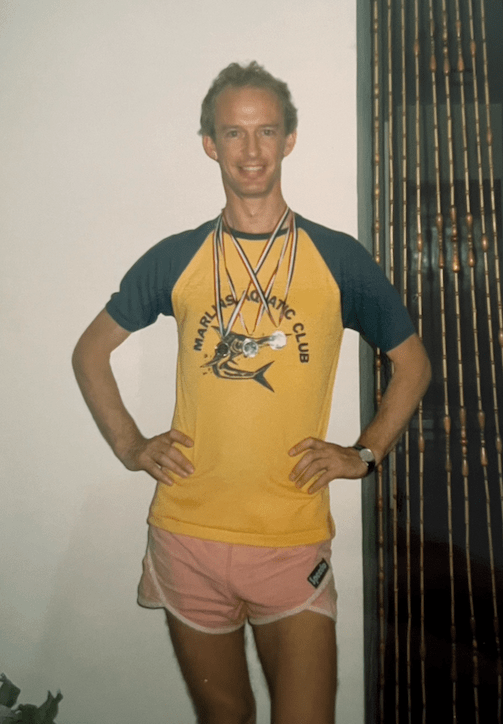
Pretending to be a winner by wearing Marilyn’s medals!
Marilyn did well, winning numerous medals, while I languished among the ‘also rans’ at the back of the field. I tried everything to win a medal: having observed that in my age group there were only two entrants in the 50 metre butterfly, I resolved to learn butterfly well enough to last a gruelling 50 metres. That way, at the next event, I would come third. It wasn’t pretty, but after working hard and amusing my fellow swimmers, I could just manage the required distance. I dutifully turned up at the next competition, having put in my entry form, only to discover a complete field of eight fit looking butterfly swimmers in my event. I came last.
My sole claim to fame was that, following our attendance at a swimming officials training course, I ended up being the starter at an international masters swimming event. You may or may not be surprised that the officials training course is quite rigorous. For example, there are strict rules concerning what must/must not be done during a turn, in addition to the complex stroke rules. During our time as officials, the rules for turning in a breaststroke race changed: formerly, both hands had to touch under the water, but now one hand can be above the water. This got us into trouble when back in Australia, when our son Nick was disqualified in a school house breaststroke race for touching with one hand above the water. The local ‘officials’ were unaware of the rule change.
There’s a few clips of our training sessions at the pool on this video, starting at just past the 30 second mark.
At the end of 1991, we moved back to Australia and settled for a couple of years in Geelong. The Wilmot family we rented from spent a lot of time at their holiday home in Lorne, and were key members of the Lorne Surf Lifesaving Club. This is the location of Australia’s most famous and enduring ocean swim race, the Pier to Pub. Having mentioned my fondness for swimming, the Wilmots convinced me to enter the upcoming race in January 1992. Knowing little about it, I turned up without a wetsuit, and suffered from the severely cold water as I scrambled through the cauldron of thrashing bodies from the distant pier to the beach. It wasn’t much fun, though it means that I have since been able to claim to have swum against one of Australia’s most famous swimmers, Keiren Perkins (who won, of course).
Unlike me, both our children were excellent butterfly swimmers. I well remember watching Nick at his school swimming sports. As well as the hands under the water breastroke fiasco, he was entered in the Open Butterfly event, as few in his house could manage the event. It looked quite amusing, as he was about 13 years old, small and skinny, swimming against a field of fully developed and fit 17 and 18 year olds. He came second, just touched out by the school champion. Equally, a year of so later Felicity represented the school in the inter school swimming carnival, winning the Under 16 50 Metres Butterfly event in fine style.
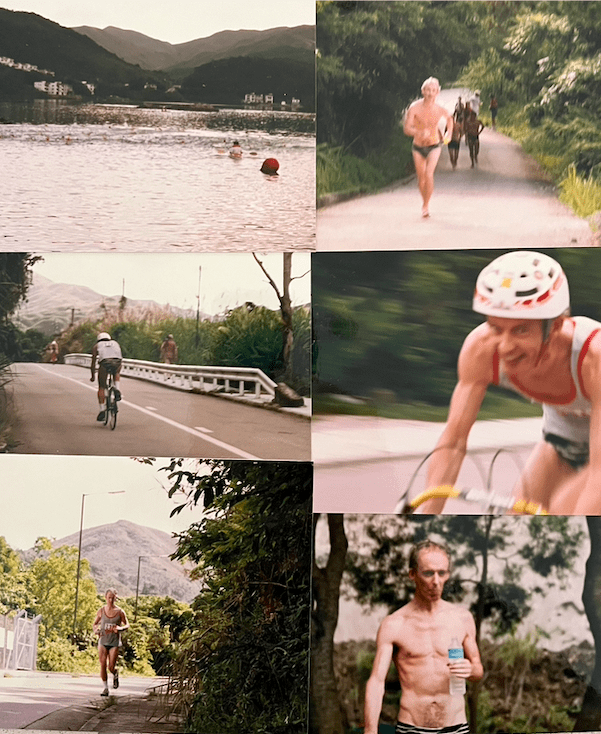 We didn’t stay long in Geelong, moving back to Hong Kong and continuing to swim recreationally. This was mostly in public swimming pools, but even better was the opportunity to swim from a friend’s pleasure junk around the outlying islands near Sai Kung (see Boating with the Robinsons). My enthusiasm also extended to attempting (and finishing, I hasten to add) a couple of ‘short’ triathlons, albeit without much training and on an old clunky bike I bought second-hand. Added to the overall misery of my performance was the onset of a nasty groin rash, brought on by the less than perfectly clean waters of Hong Kong.
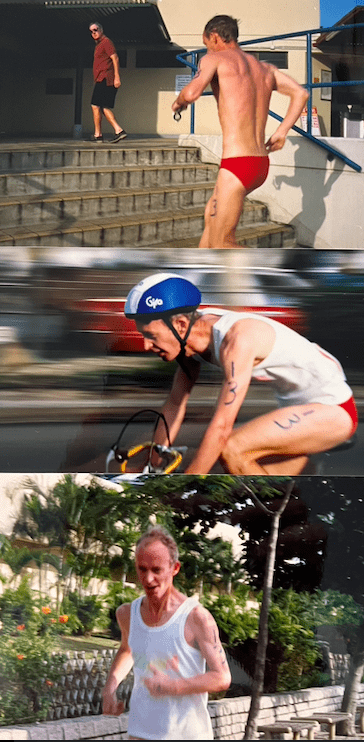 Thankfully, the swim for the second one was in a pool, as the first leg in a badly named ‘sprint’ triathlon: you can be assured that there was certainly no sprinting on my part. It was held on the Island, at what is now the Police Officers’ Club, and used to be in army hands.
We kept up our swimming over the years, as we moved backwards and forwards between Australia and Hong Kong, finally settling in Melbourne in 2004. Our regular pool was in Ashburton, where we met a swimmer of our vintage who was also keen on ocean racing. Eventually John convinced us to give it a try, and we turned up on a nice sunny morning at Dromana for the annual ocean swim race around the pier and along the beach, a distance of about 1.2 km (i.e. not too long for first-timers).
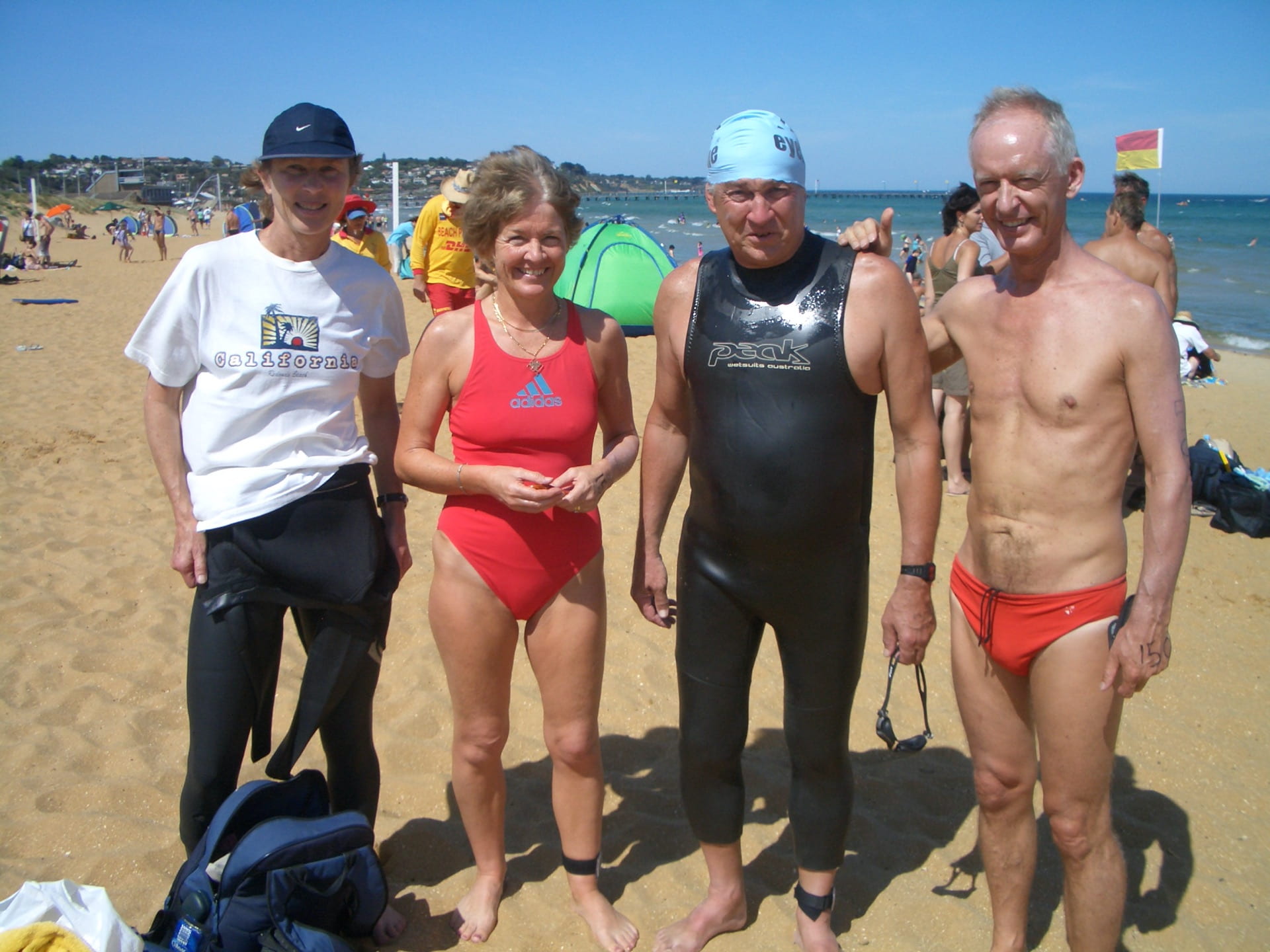
I don’t remember our placings, but Marilyn certainly beat both John and I!
We still didn’t have wetsuits, unlike most of the competitors, who not only used them for warmth but appreciated the additional floatation that a wetsuit affords.
Overall, it was a positive experience: the water, though cold, wasn’t too rough; we sustained no injuries from flailing limbs; and our fellow competitors were a nice chatty bunch, especially in our older age group. And the counter lunch with a cold beer afterwards was a fine reward for our efforts.
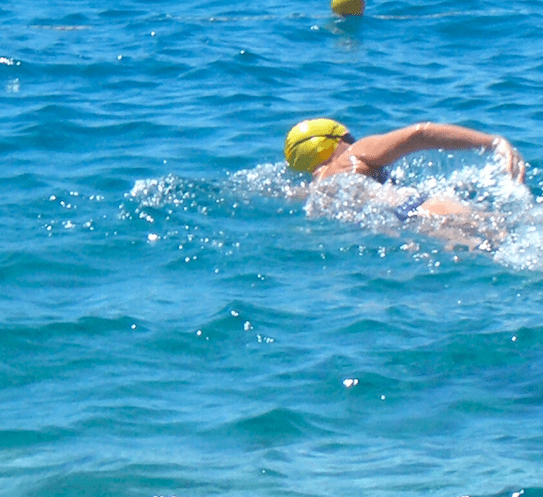
My usual view of Marilyn before she disappeared into the distance
So began a few years of regularly signing up for ocean swim races in a variety of locations around Victoria. Most were at various life-saving clubs that are dotted around Port Philip, though we did go in the Point Lonsdale event which is at the Heads, leading out into Bass Strait. This is where Marilyn had her best ever result, second in the women’s event for her age group. Her prizes comprised merchandise and a cheque for $100. It was only later that evening, when the overall results were listed, that we realised that she’d had an unfair advantage: she’d started five minutes ahead of the other women by heading off with the men’s group! She was so busy chatting to other competitors that she hadn’t realised the error. 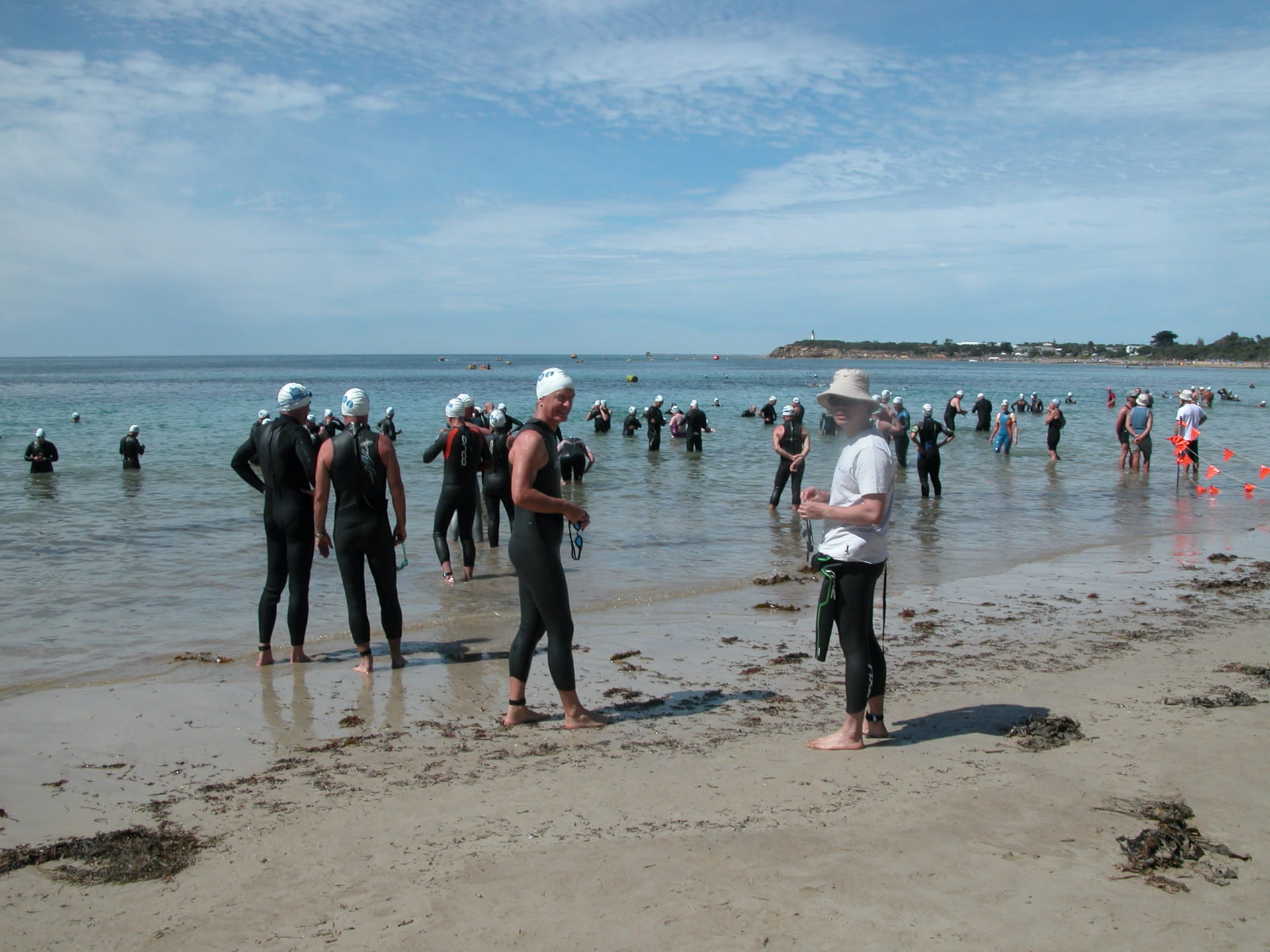 It’s at least partially excusable, in that for some events both male and female competitors started together, while in others they were separated. Anyway, the upshot was that we phoned the organisers to admit her sin, and they were forgiving, allowing her to keep the merchandise while we suggested just tearing up the cheque.

The longest swim race we competed in was the Port Melbourne to Williamstown event, a distance of nearly three and a half kilometres. It was difficult, especially as the course crosses a shipping lane, and we had to be clear of it within a time limit. As usual I struggled near the back, while Marilyn powered ahead and beat me by about 20 minutes.
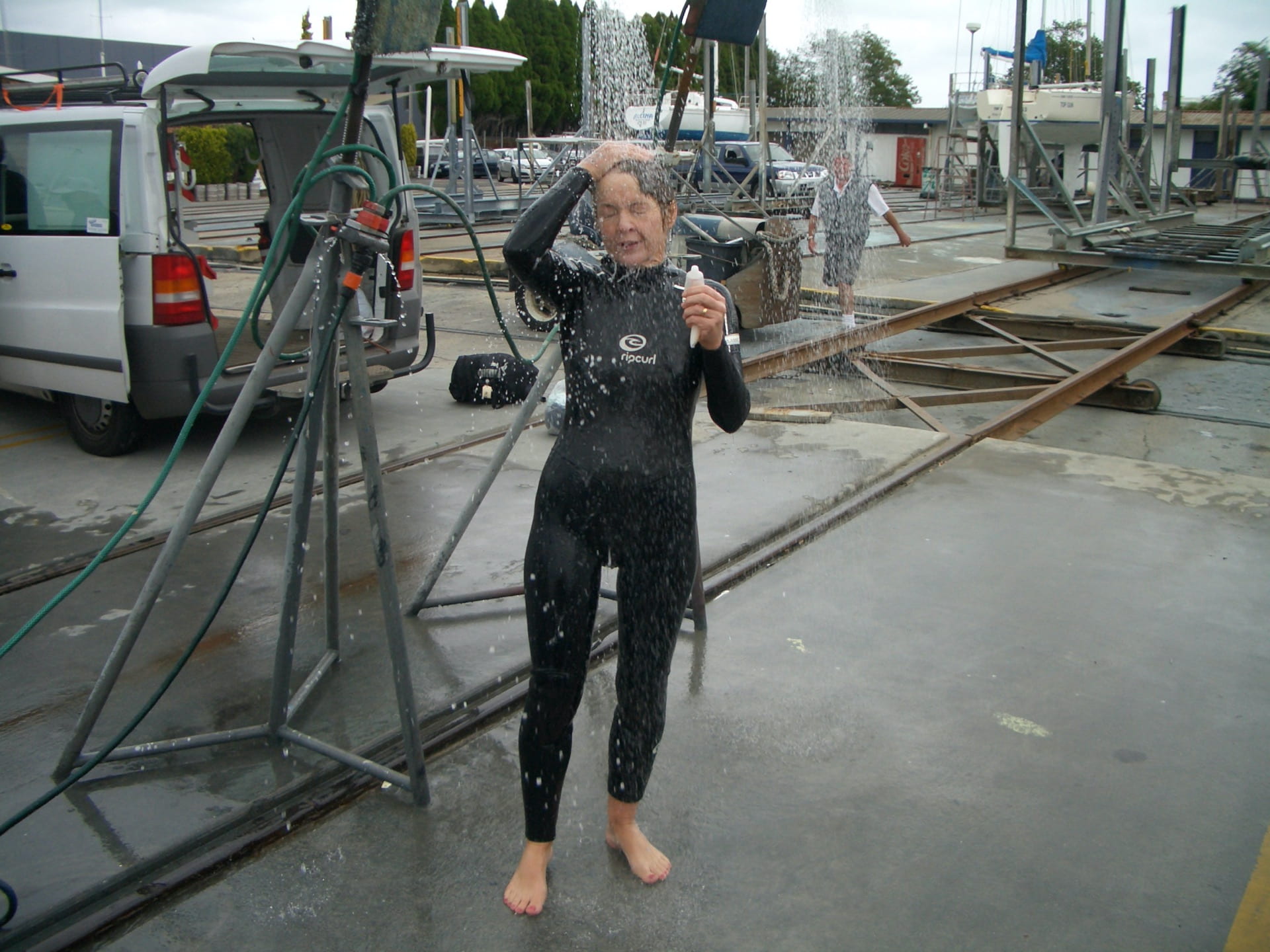
Shower facilities at Williamstown wharf
A year later we tried again, and strictly speaking I can claim that it was the only time I vanquished her. However, it was only because Marilyn didn’t finish: the course was littered with stinging jellyfish, she freaked and was taken out of the water by one of the rescue craft. I doggedly persisted, having been reassured before the start that the stings were not dangerous. That might have been true, but they were painful, and I was covered on the face and arms by the finish, where we were handed some spray to help ease the agony.

Nice quiet day at Carnegie pool
Most of our swimming was in pools, though, as it became our main recreational pursuit. As I entered retirement, we were able to regularly swim two or three times a week in a variety of local pools, always preferring the outside to the inside. Australia in general, and Melbourne in particular, is blessed with public swimming pools, our local favourites being in Carnegie, Ashburton, Malvern and Oakleigh. The Malvern pool, by the way, is somewhat amusingly named after Harold Holt, our only Prime Minister to have drowned while in office.
Most of our weekend swims usually included our good friend Nick Way, who continues to swim with me till this day. Here’s a short video taken nearly 15 years ago of Marilyn demonstrating her tumble turn, while Nick watches on. I hasten to add that neither Nick nor I can manage it.
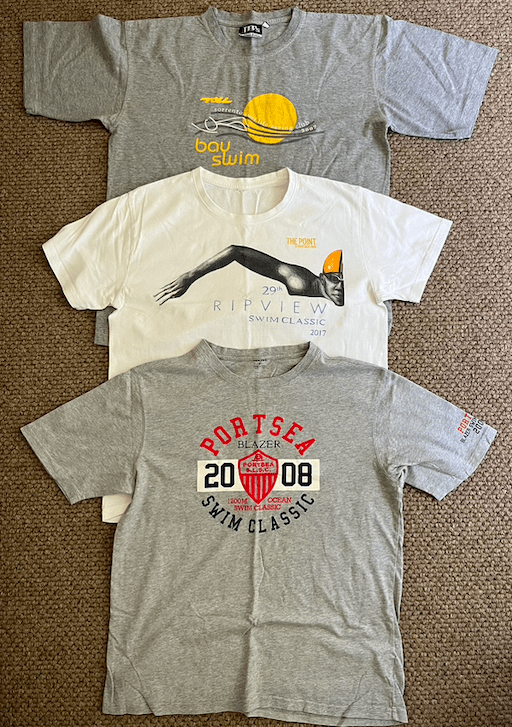
The entry fee usually included a T-shirt
And so we come to my last ocean race, in January 2017. Yes, it was the middle of summer, and I decided to go back to Point Lonsdale, which in the past had been an easy swim on a sunny, pleasant day. Not this time, I’m afraid. It was cold (16 degrees C) and windy, with choppy conditions. I’d already paid my entry fee of $50, so made the long drive to the Bellarine Peninsular for the event. A somewhat disgruntled group meandered along the foreshore to the starting line, where we had to wait well past the scheduled starting time, due to some unexplained delay. Already not in the mood, I headed out amongst the splaying bodies into the swim channel, marked out by the occasional buoy to guide us.
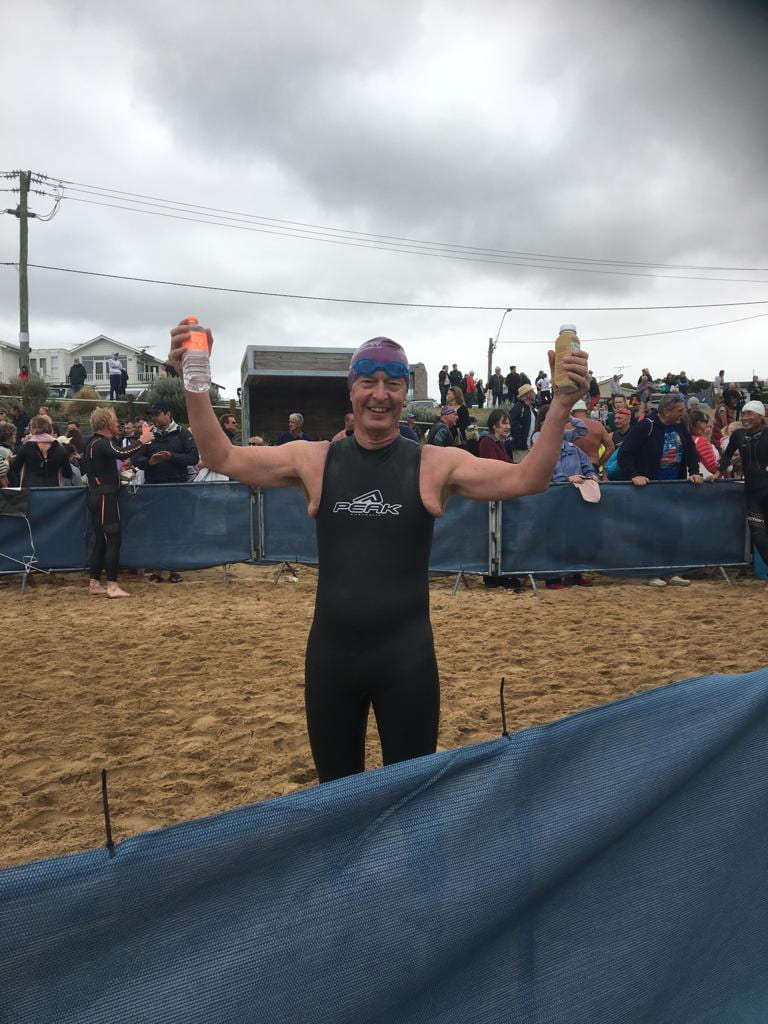
Looking better than I felt
I’m not great at swimming straight lines in the ocean at the best of time, and the conditions meant that I strayed well wide of the allotted route. Pausing to look around, in my miserable state I wondered what the hell I was doing. Resolving never to do it again, I floundered to the finish line and staggered ashore. Poor friend Linda, who had waited an inordinate time freezing by the shore waiting for me to emerge, failed to recognise me at first as I lurched up the beach. Changing as quickly as possible, we headed off to Queenscliff for a recovery lunch, where I announced my retirement decision. She wasn’t surprised.
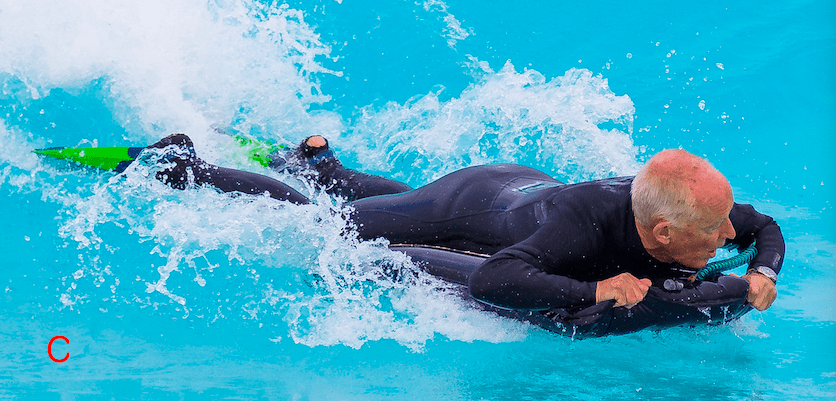 I still swim regularly. Nick Way and I manage to put in our laps at least once a week, and my usual distance is 30 laps in a 50 metre pool. Twenty of the laps are with flippers (10 with kick board), as I try to keep my legs strong for my other leisure activity on a surf mat. Nick and I plan to keep going as long as we can, so hopefully there’s a few years left in us yet.