 Near the heart of Hobart, the capital of the delightful island of Tasmania, is a traditionally styled Anglican cathedral (completed 1823), dedicated to St David.
In 1960, for some unknown reason, Mrs Margaret Murphy and her friend Mrs Judith Woollard decided to take their boys, David (me) and Charlie, aged nine years, to audition for St David’s choir. We were both accepted, and thus began four years of what in retrospect was a transformational experience.
Like most choirs, we were divided into four groups; sopranos, contraltos (better known as altos), tenors and bass/baritones. As sopranos often break into harmony, we were further subdivided into Decani (upper part) and Cantoris (lower part). I happily went into Decani (we always felt slightly superior – the top notes were ours) and Charlie into Cantoris.
The choir practised twice a week, in a hall at the rear of the cathedral. On Tuesday after school it was just the sopranos (all boys). Decani on one side and Cantoris on the other, seated according to rank from Head Chorister to most junior (me). The head of Decani was Andrew Webber, son of the Dean of Hobart, the Reverend Michael Webber (an intelligent man of the highest integrity, as I recently discovered). Interesting family, the Webbers: very English, with three daughters alongside Andrew – Helen, Elizabeth and Margaret. During Sunday service the Webber family would sit in their pew at the front of the stalls, nice for me as I found one of them rather attractive.

Lyndon Shea
Alongside Andrew were John Clennett, Michael Wertheimer and Tim Peters, among others. Tim and I soon became good friends, partly, I surmise, because neither of us attended the Anglican Church School, Hutchins, the main feeder to the choir. The head of Cantoris was Chris Ricketts (great footballer, later starred for Sandy Bay Seagulls), with the human rights activist Lyndon Shea as his number two.
The choirmaster was the City Organist, John Nicholls. A world class musician (scholarship winner at London’s Royal College of Music), he somehow got the rag-tag collection of adolescent boys to produce harmonies of the highest level, teaching us dozens, if not hundreds, of traditional hymns and anthems, many of which are still firmly planted in my consciousness. In retrospect I’m really not sure how he did it: he neither shouted nor bullied, just carried us along in his passion for excellence. He also introduced us to the master of choral music, Bach, whose music I love (alongside other ex-choirboys such as Jack Bruce and Keith Richards).

On Thursdays the choir practice was held in the evening so that the rest of the choir, all adults, could attend. It wasn’t all male: a couple of the altos were female. Incidentally, remember this was the 1960s. I was a 9-year-old boy who, when practice finished after dark at 9:30 pm, would catch a bus home.

In the choir stalls on a visit to Hobart in 2016
It might surprise you to learn that we (the boys, not the adults) were paid. It was a sliding scale, with the rate per term being six pounds for head boy (this is pre decimal currency) down to ten shillings for me. In addition, if we sang at a wedding (usually just the boys), the groom was required to hand over thirty shillings, to be divided equally among whichever boys turned up. The best one ever was when only three of us appeared! Ten shillings was a lot to a young boy back then, especially as my mother kept the term payment, but allowed me to keep any wedding ceremony money.

The worn steps leading up from the crypt
The main weekly service for the choir was held on Sunday morning. We’d not enter via the impressive front doors, but go to the back of the cathedral and descend the stone steps into the crypt. There we would don a cassock and surplus, with each head boy wearing a wide purple ribbon with a medallion attached around the neck. The two next senior boys were similarly attired though their red ribbons were narrower and their medallions smaller. I eagerly looked forward to the day when, god willing, I might wear this symbol of seniority which we referred to as a ‘dangle’.

Heading up from the crypt
We’d then ascend an internal staircase which took us through the Dean’s office and around to the back of the organ. Once it started, we formed a procession behind the verger and walk in front of the congregation to the choir stalls, just back from the altar, Decani on the side closer to the organist and Cantoris by the organ pipes on the other side.
The purple cassocks were quite warm, and during summer became rather stifling. This led to a personal incident: one hot summer Sunday morning we were belting out the Apostles Creed (yes, there are versions we sang rather than just reciting) and I started to feel somewhat wheezy. Next thing I know I wake up back in the Dean’s office being given smelling salts to revitalise my senses. Yes I’d fainted, and apparently made quite a spectacular noise as I crashed to the tiles. Aware of the symptoms, from that time I was cautious, and was advised to sit down and stick my head between my knees if I felt it coming on. I have a vague notion that my mother also supplied me with a small green bottle of smelling salts.
As anyone who’s tried it will attest, there’s something special about singing in a choir. All the more so when you are singing in a cathedral, with its excellent acoustics and the magnificence of a full-blown church organ. The choir was positioned adjacent to the pipes, so that you not only heard the sound, but felt it through the floor when John Nicholls let loose with the best of Bach. And yes, we sang all the well known church music, highlights being the annual Christmas carols and Handel’s Messiah. My own favourite was Hubert Parry’s ‘I Was Glad’ (sung at William and Catherine’s wedding), partly because at the climactic final, we in Decani hit one of the top notes (a B Flat for the word ‘palaces’) in the soprano’s repertoire. But the highpoint of performances while I was in St David’s choir takes us again to Johann Sebastian Bach. Just imagine, not just a cathedral setting with choir and soloists, but the full Tasmanian Symphony Orchestra joining in a magnificent performance of the St Mathew Passion. Many months in preparation, it was a truly memorable occasion.
Another memorable occasion is from the other end of the performance spectrum. Did anything ever go wrong? Well, yes, one incident stands out. Every now and then the choir would sing unaccompanied. We were to perform a light, delicate piece (the name escapes me) which starts with the altos. John Nicholls would softly play the opening note (for the choir’s ears only), then move to the central aisle to conduct the piece. All was going well until the voices of the altos pierced the silence. They couldn’t find the right note – it was confused discord. They stopped. The choirmaster raised his arms to start them again, but no, they muffed it. With his colour rising and steam issuing from his ears, Mr Nicholls stormed past me (muttering ‘Oh bloody oath!’) back to the keyboard and blasted out the required note. This time the altos got off to a good start and we all joined in, but the delicate moment had been lost.
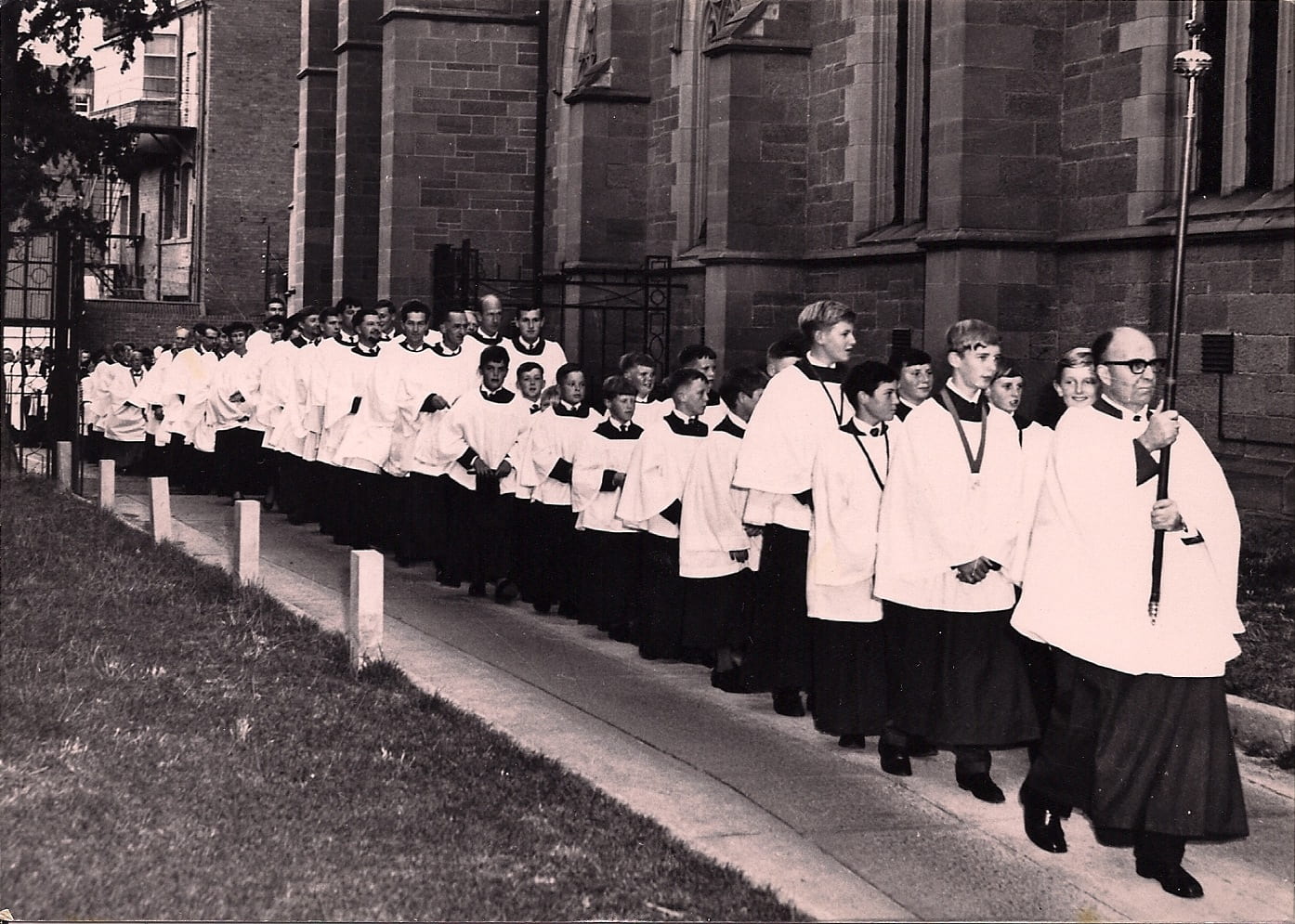 Other grand events included the inauguration of a new bishop, specifically that of Bishop Davies in 1963. Fortuitously, there’s a photo of the choir making its way around the side of the cathedral to enter by the front doors. Yes that’s me at the front (having achieved head boy status), alongside Richard Bates (partially obscured), the pair behind us being Chris Mills and David Thorp, and behind them the aforementioned Charlie Woollard and Frank Bansel. I’ll spare you the names of the rest, as many of them escape me.
A strong memory of the time was the annual choir camp, held at Coningham, south of Hobart. The camp was held in an idyllic bushland setting, near the mouth of the Derwent River. This gave us opportunity to partake in one of our two favourite activities, spear-fishing. Most of us would turn up at camp with our goggles, snorkel and flippers, each with a home-made spear, assembled by attaching a couple of metal barbs to an old broom handle. We even managed to spear the occasional edible fish (alongside the poisonous puffer fish), the best ever being the large conger eel captured by the adventurous Simon Gethin.
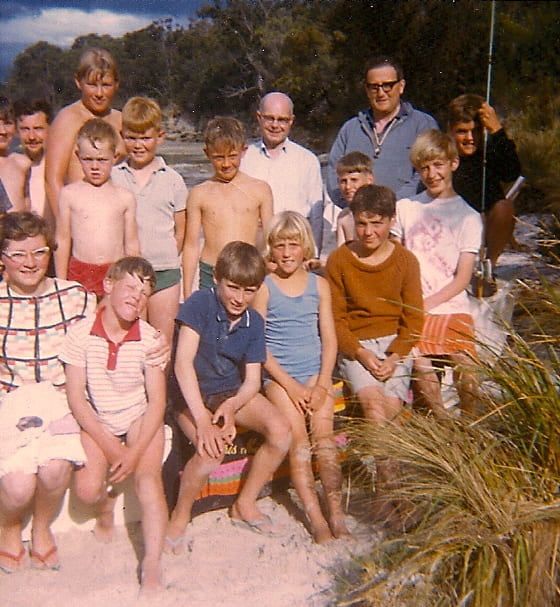
Choir Camp at Conningham – John Nicholls is in the middle at the back
Yes, of course we had choir practice twice a day, but for us it was secondary to our underwater escapades, as well as our other main activity, smoking. During free time, a few of us would walk to the nearby town (Snug), where the proprietor of the local store would happily sell us our required packets of Alpine and Benson and Hedges.
One year at camp we were visited by an ABC television crew, who made a short segment for the evening news. I have a clear memory of going to the ABC offices to see a preview, during which I accidentally put a folding chair seat onto Tim Peters’ hand, slashing a finger and necessitating a visit to the hospital for stitches. In more recent years I’ve searched the relevant archives for the footage, but to no avail. So there is thus, as far as I know, no recording of St David’s Cathedral choir during the time I was a member. At one stage my mother tried to convince me to have a recording done of my singing, but I stupidly refused to cooperate.
So how did it all end? Just as you’d imagine – my voice broke. I remember it only too well. Each year at Christmas time a few of the boys would visit the Royal Hobart Hospital and sing Carols to the patients. It was not in the form of a concert, rather we’d go from ward to ward, warbling the usual favourites. It was during a rendition of ‘Once in Royal David’s City’ that I was required to come in solo with the line ‘Sire he lives a good league hence’, but all that came out was a strangled squawk. After two feeble attempts I gave up, and Chris Mills took over – deeply embarrassing. I continued for a couple of months, but essentially it was all over, though I did have the honour of reading the first lesson at the Christmas Carol service in the Cathedral – my last hurrah.
I’ve not had much contact with my fellow choristers during the decades which followed this part of my life, though a few years ago I did manage to catch up with Tim Peters. He’s a skilled craftsman who constructs wooden boats in Hobart, and we shared fond memories of our time as choristers over a particularly nice glass of red wine.